Air conditioning for Leamington Spa homes, flats and studios
We install, look after and repair air conditioning across Leamington Spa, for Regency flats, family homes, studios and shops. Most units we install run both ways, so the system that cools a top-floor bedroom in a heatwave can also warm it through January. Tell us the room and postcode, and we will call back.
Get a quote
Name, number, postcode. We call you back to talk it through.
- Survey first, then a written price
- Listed and conservation area homes
- Cooling and heating from one unit
How hot does Leamington Spa actually get?
Each railing is one month's average daytime high at Wellesbourne, the Met Office climate station about seven miles south of the town. Gilt tips mark the months a reversible system mostly cools. Iron tips mark the months it mostly heats.
- 8 degrees average high, mostly heatingJanuary
- 8 degrees average high, mostly heatingFebruary
- 11 degrees average high, mostly heatingMarch
- 14 degrees average high, mostly heatingApril
- 17 degrees average highMay
- 20 degrees average high, mostly coolingJune
- 23 degrees average high, mostly coolingJuly
- 22 degrees average high, mostly coolingAugust
- 19 degrees average highSeptember
- 15 degrees average high, mostly heatingOctober
- 11 degrees average high, mostly heatingNovember
- 8 degrees average high, mostly heatingDecember
Mean daily maximum in °C, 1991 to 2020. Wellesbourne also averages about 47 days of air frost and 1,547 hours of sunshine a year. A heatwave climbs well above these averages, which is when a top floor stops being liveable. Source: Met Office.
Can you fit air conditioning to a Regency building?
Usually, yes, but the position of the outdoor unit decides how much paperwork comes with it. Leamington grew from 315 residents in 1801 to 15,724 by 1851, and much of what it built in those decades still stands. Work on the Parade began in 1808, the Royal Pump Rooms opened in 1814, and Lansdowne Crescent followed in the 1830s.
Warwick District Council divides the Royal Leamington Spa conservation area into 37 character areas, taking in the Parade, Regent Street, Bath Street, Clarendon Square, Lansdowne Circus and many more streets. Inside a conservation area, the home planning rules exclude any wall or roof that faces a road, and the ground between the building and that road.
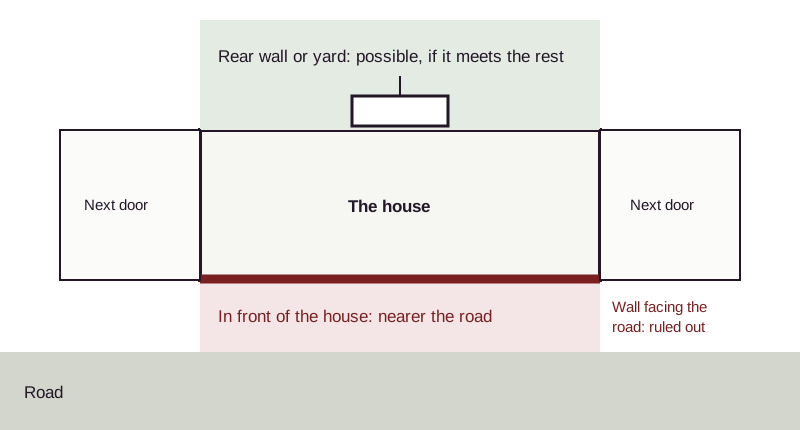
So the back of the house is where most of our surveys begin. Our air conditioning planning permission guide has the full list of rules. Sources: Wikipedia; Warwick District Council; Planning Portal.
What changes if your home is listed?
Permitted development falls away completely. A listed building and its grounds get no automatic planning rights for a heat pump, and work that affects the building's special character needs listed building consent, inside as well as out. Going ahead without it is a criminal offence. The maximum penalty on indictment is two years in prison, a fine, or both.
That sounds worse than it usually is. Historic England said in 2023 that heat pumps will generally be acceptable on listed buildings if they are sited with care, while warning that the installation itself can sometimes do harm. In Leamington the council's own guide describes every building on Lansdowne Crescent as Grade II*, and it records Article 4 control over colour on the Parade, Bath Street, Clarendon Square and the Crescent. Our guide to air conditioning in listed buildings sets out the order to do things in. Sources: Listed Buildings Act, section 7; section 9; The Construction Index; Warwick District Council.
Who has to agree if you live in a converted flat?
Whoever owns the outside walls, and possibly the council too. A lease can allow alterations with consent or ban them altogether, and a freeholder can recover reasonable costs for granting a licence. When the work touches walls or a roof the freeholder keeps, the law sets no ceiling on any premium it asks.
Planning adds a twist that catches out many flats in this town. The permitted development rules for flats only apply to a block made up wholly of flats. If there is a shop or café on the ground floor, as on so much of Regent Street and Clemens Street, those rights are not available and a planning application is the likely route.
In Warwick district 19.0% of households rent privately and 14.1% rent socially, and Leamington has controlled the change from family house to small shared house since April 2012. If you rent, start with your landlord. The guide for flats goes through each case. Sources: LEASE; LEASE on charges; Planning Portal; ONS; Warwick District Council.
Why are more Leamington households asking for cooling?
Because the last two summers each broke the record. The UK's mean summer temperature reached 16.1°C in 2025 and 16.5°C in 2026, with five heatwaves in that second year and a peak of 38.1°C at Kew on 13 August.
The first room to give up is usually one you sleep in. Research for the government in 2019 used 26°C overnight as the bedroom limit, and estimated that overheating could cut a good night from eight hours to six or seven. It also found that over half of households sometimes feel unable to open windows, mostly because of security or noise. Our page on home air conditioning starts there, and the bedroom guide compares the options. Sources: ITV News, reporting the Met Office; GOV.UK.
Homes and flats
Start with the room you avoid in July. That might be a bedroom at the top of a converted villa, a loft conversion, a glass-roofed extension or a whole floor of a family house.
Air conditioning installation
Survey, consents, fitting and start-up, in that order.
Home air conditioning
Quiet systems for bedrooms, top floors and family rooms.
Air-to-air heat pumps
One system for winter warmth and summer cooling, room by room.
Multi-split air conditioning
Several rooms on one outdoor unit, each with its own controller.
Conservatory air conditioning
Makes a glass room or garden office usable in July and January.
Studios, shops and offices
Leamington has dozens of game studios, along with the shops, salons and restaurants of the Parade and Regent Street. Rooms full of screens and people run warm, and employers have to keep their indoor spaces at a reasonable temperature.
Servicing and faults
Already got a system? We look after units whoever fitted them. Still pricing the idea up? Begin with what air conditioning costs.
How does the same unit keep a house warm?
Swap the direction of the refrigerant and an air conditioner becomes an air-to-air heat pump, taking heat from the air outside even on a cold morning. The Energy Saving Trust puts seasonal heating efficiency at typically above 4.0, meaning one kWh of electricity delivers four of warmth. On the October to December 2026 price cap of 26.32p per kWh, that is about 6.6p for a kWh of warmth, against the full 26.32p from a plug-in heater.
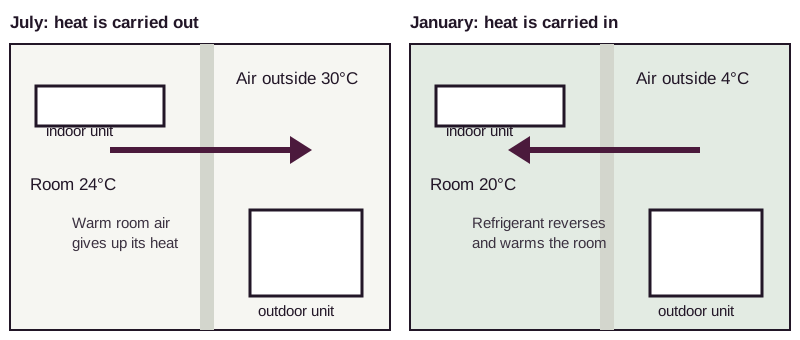
It warms the air in a room, not your radiators or your hot water, so most people keep the boiler. Gas under the same cap is 7.97p per kWh before boiler losses, so the sums are closest in a house with an efficient boiler. Read more about air-to-air heat pumps. Sources: Energy Saving Trust; Ofgem.
What does cooling a game studio or office involve?
Leamington is the centre of what its MP described to Parliament in 2021 as the Silicon Spa cluster: over 2,000 people in 32 studios, and more than 10% of the UK's games development sector. A floor of high-powered PCs is a heater that never takes a day off, because almost every watt a machine draws ends up as warmth in the room.
Nobody has written a top limit into workplace law. Indoor temperatures only have to be reasonable, though the Health and Safety Executive expects employers to assess heat as they would any other hazard. Larger systems bring one more duty: anything over 12kW in total must be inspected for energy use at intervals of up to five years. See office air conditioning, shops and restaurants and server room cooling. Sources: Parallel Parliament; legislation.gov.uk; HSE; GOV.UK.
What should you ask any installer before paying?
Ask for the company's F-gas certificate and the qualification of whoever handles the refrigerant. A business working on other people's systems must be certified by an approved body, and that includes sole traders. The certificate runs for three years. Each engineer needs a personal qualification as well.
Then ask who certifies the electrics, because a new circuit is notifiable work, and ask to see the sound calculation for your neighbour's nearest window. Ask us too. You can verify what you are told by following our F-gas certificate guide. Sources: GOV.UK on companies; GOV.UK on qualifications; Warwick District Council on Part P.
Where else do we work?
Leamington Spa first, then the towns around it. Each page below picks out what sets that town apart: its housing, its council and its planning position.
Air conditioning in Warwick
Air conditioning in Kenilworth
Air conditioning in Stratford-upon-Avon
Air conditioning in Coventry
Air conditioning in Rugby
Air conditioning in Solihull
Other places we cover
- Leamington Spa town, including Lillington, Milverton, Sydenham and Campion Hills (CV31, CV32)
- Whitnash and Radford Semele (CV31)
- Cubbington and Offchurch (CV32, CV33)
- Barford, Hatton and Hampton Magna (CV35)
- Wellesbourne and Kineton (CV35)
- Southam, Harbury and Bishop's Itchington (CV33, CV47)
- Henley-in-Arden (B95)
- Alcester and Bidford-on-Avon (B49, B50)
- Knowle and Dorridge (B93)
- Balsall Common and Hampton-in-Arden (CV7, B92)
What happens after you get in touch?
You tell us about the room
Ring 01926 967778 or send the form with your postcode, and say which rooms bother you and when.
We survey the building
We measure up, check the walls and the power, ask about the lease or listing, and agree a place for the outdoor unit. A written price follows.
Consents come before drilling
If a landlord, a freeholder or the council has to say yes, that happens now. Nothing goes on a wall until it has.
We fit, test and hand over
Units, pipework and power go in, then the system is pressure tested and started up. You leave with the certificates and know the controls. Yearly servicing keeps it right.
Reading to help you decide
How much does air conditioning cost?
Fitted prices, electrics, running costs and the extras people forget.
Does air conditioning need planning permission?
The permitted development conditions, with the Leamington exceptions.
Can you have air conditioning in a listed building?
Consent, siting and humidity, for Grade II and Grade II* homes.
Is air conditioning allowed in a flat?
Leases, freeholders, planning limits and flats above shops.
Is air conditioning for a bedroom worth it?
How hot is too hot, what size to buy and what a night costs.
Air conditioning for a loft conversion: what works?
Why lofts overheat, and where units go under a sloping roof.
What size air conditioner do you need?
A room size table in kW and BTU, plus when to go larger.
How do you check the F-gas register for an installer?
Company certificates, personal qualifications and who to ask.
Portable against fixed air conditioning: which wins?
An honest comparison, including when a portable is the better buy.
What people in Leamington ask us
What does air conditioning cost to fit in Leamington Spa?
We quote after a survey. As a national guide, Checkatrade's May 2026 figures run from about £1,900 for a 12,000 BTU wall unit fitted to about £2,240 for 24,000 BTU, with electrics usually adding £400 to £700. Consents can add to that on a listed building or a leasehold flat. See the cost guide.
Can a unit go on the front of a house in the conservation area?
Not under permitted development. The rules exclude walls and roofs that face a road. A planning application is possible, but the rear is usually the better first idea.
My flat is above a shop. Does that matter?
Yes. The automatic planning rights for flats only cover a block made up wholly of flats, so expect to need planning permission as well as your freeholder's consent.
Will the system also heat my home?
A reversible unit will heat the room it serves. It does not feed radiators or make hot water, so most people keep their boiler. Our air-to-air heat pump page explains why.
Do you repair systems you did not install?
Yes. Give us the make, the model and any code on the display, and we can say more on the first call. See repairs.
Which places do you cover?
Leamington Spa, Warwick, Kenilworth, Stratford-upon-Avon, Coventry, Rugby, Solihull and the villages in between. Every place is on our areas page.
Want us to call you?
Tell us where you are and what is too hot or too cold. Or ring 01926 967778.